





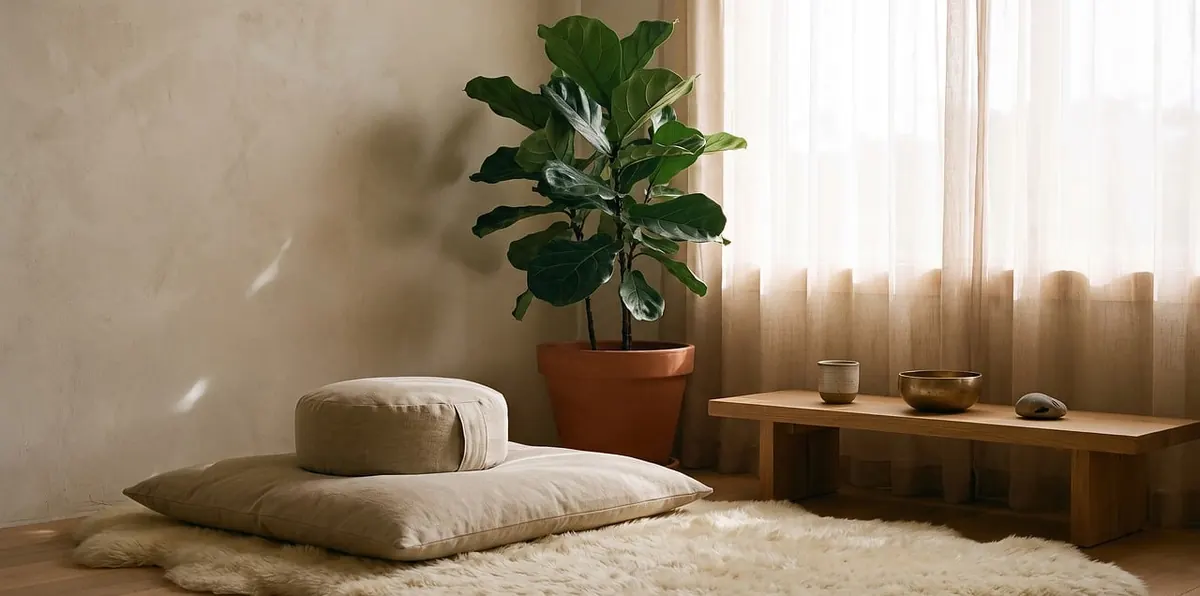
Most people don't abandon mindfulness because it failed them. They stop because of a misunderstanding they never quite named — that their mind was too busy, that they weren't the type, that a proper practice needs twenty quiet minutes and a cushion. None of that is true, and none of it is the reason the habit slipped. What follows are the mistakes that come up again and again, and the small adjustments that separate a practice which lasts ten years from one that fizzles out by the spring.
Believing the aim is an empty mind
Ask a room of beginners what meditation is for and most will say something about clearing the head. That single idea undoes more practices than any other. Thoughts are not the enemy of attention; they're the weather it happens in. If you sit for ten minutes and notice your attention has wandered thirty times, you haven't failed thirty times. You've noticed thirty times, which is thirty repetitions of the actual skill — the moment of noticing.
Nobody goes for a run expecting to arrive already fit. You go because the effort is the training. The busy mind you meet on the cushion isn't an obstacle to practice; it's the material. The only real failure is not noticing at all.
Grading every session
Once you've decided a sit can go well or badly, you've handed your practice over to your mood. A restless session gets marked down; a calm one gets chased. Within a fortnight the whole thing feels like homework with no marks.
Try dropping the verdict and keeping the observation instead: mind was busy, shoulders were tight, I kept coming back to the breath. That's a description, not a score — and it tells you something useful about your week. If you use an app, watch how the streak counter behaves in your head. A streak is a decent nudge and a terrible judge. Missing a day breaks a number, not a practice.
Starting bigger than you can sustain
Thirty minutes a day sounds serious, and seriousness is often what people are after at the start. But a practice has to survive a bad night's sleep, a late meeting, a poorly child. If your minimum is half an hour, the first difficult week will end it. Size it for your worst day, not your best.
- Choose a length you could manage tired, rushed or unwell. For most people that means two to five minutes.
- Attach it to something that already happens reliably: the kettle boiling, brushing your teeth, the start of your commute.
- Define "done" in a way you can't argue with — the timer finishing, or ten conscious breaths.
- Keep the same time and place for a fortnight before you change anything.
Waiting for the right conditions?
You don't need a quiet room or a cushion. You can practise on a bus, in a parked car, in a waiting room, or on the edge of the bed before you get up. Noise isn't a problem to be solved; it's simply part of what's happening. The best conditions are the ones you actually have.
Saving it for the bad days
Mindfulness is often discovered during a difficult stretch — anxiety, grief, exhaustion — which is understandable, but it shapes the habit badly. If practice only appears when things go wrong, it starts to feel like a distress signal. Sitting down becomes a way of reminding yourself that you're struggling.
Ordinary days are where the skill is built. Ten minutes on a Tuesday when nothing is wrong isn't a wasted session; it's the one that makes the harder sessions possible. You can't learn to swim in the middle of a storm.
Chasing the calm
Sooner or later you'll have a session that feels spacious and clear, and the temptation is to spend every session afterwards trying to get it back. That grasping is what makes practice tense. Calm is a by-product, not a target, and it doesn't arrive on request.
Some sits are restless, some are dull, some are peaceful. All three are worth turning up for. If you're using mindfulness mainly to manage stress, low mood or a health condition, it tends to work best alongside proper support — speak to your GP or a qualified teacher rather than treating it as a substitute for care.
Leaving it on the cushion
Formal practice is where you learn to notice; the rest of the day is where it counts. If the only time you pay attention is while a timer is running, the skill stays small and oddly separate from your life. Three places to catch yourself:
- The first three breaths after you sit down at your desk
- The walk to the kettle, the lift or the front door
- The pause between reading a message and replying to it
None of these need extra time. They need the same move you've already practised: notice you've gone, and come back.
The smallest version you'll actually do
If your practice has stalled, resist the urge to restart with a grand plan. Cut it in half, then halve it again until it feels almost too easy. Three minutes a day, every day, for a month will teach you more than an hour on a Sunday followed by nothing for a fortnight.
Then keep one question close: what's actually happening right now? Not what should be, not what you'd prefer. That question, asked often and answered honestly, is the whole practice. Cushions, apps, timers and retreats are just scaffolding around it — useful, replaceable, and never the point.
Photo: FREEDOM_Ai_Studio / Pixabay